Ordinary Council Meeting
6:00pm 22 April 2025
Council Chamber (Level 1), Civic Centre,
23 Dundebar Road, Wanneroo
wanneroo.wa.gov.au
Ordinary Council Meeting
6:00pm 22 April 2025
Council Chamber (Level 1), Civic Centre,
23 Dundebar Road, Wanneroo
wanneroo.wa.gov.au

Notice is given that the next Ordinary Council Meeting
will be held in the
Council Chamber (Level 1), Civic Centre,
23 Dundebar Road, Wanneroo on Tuesday 22 April 2025 commencing at 6:00pm.
B Parker
Chief Executive Officer
15 April 2025
CONTENTS
CE01-04/25 **Licence Refusal Objection
Item 10 Late Reports
File Ref: 25242 – 25/115677
Responsible Officer: Chief Executive Officer
Attachments: 4
Changes to Report and Additional Information Arising from Agenda Briefing
1. Under the Comments heading, additional comments added to the Response by Administration column.
|
Objection Point |
Response by Submitter |
Response by Administration |
|
1. Health and Safety Concerns |
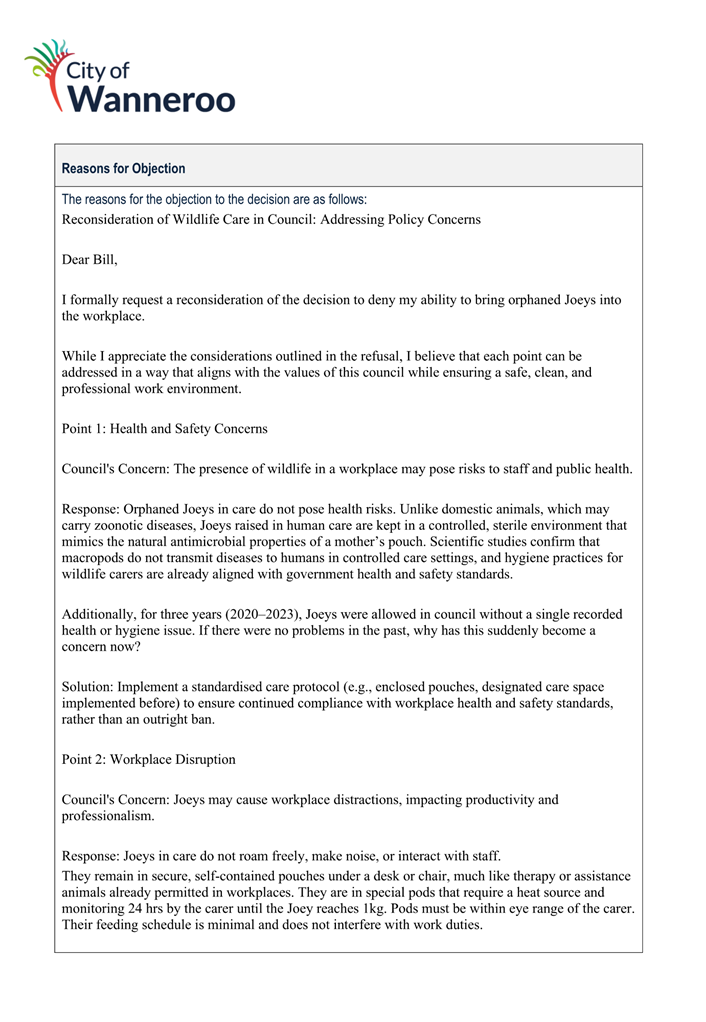
Orphaned Joeys in care do not pose health risks. Unlike domestic animals, which may carry zoonotic diseases, Joeys raised in human care are kept in a controlled, sterile environment that mimics the natural antimicrobial properties of a mother’s pouch. Scientific studies confirm that macropods do not transmit diseases to humans in controlled care settings, and hygiene practices for wildlife carers are already aligned with government health and safety standards.
Additionally, for three years (2020–2023), Joeys were allowed in council without a single recorded health or hygiene issue. If there were no problems in the past, why has this suddenly become a concern now?
Solution: Implement a standardised care protocol (e.g., enclosed pouches, designated care space implemented before) to ensure continued compliance with workplace health and safety standards, rather than an outright ban. |
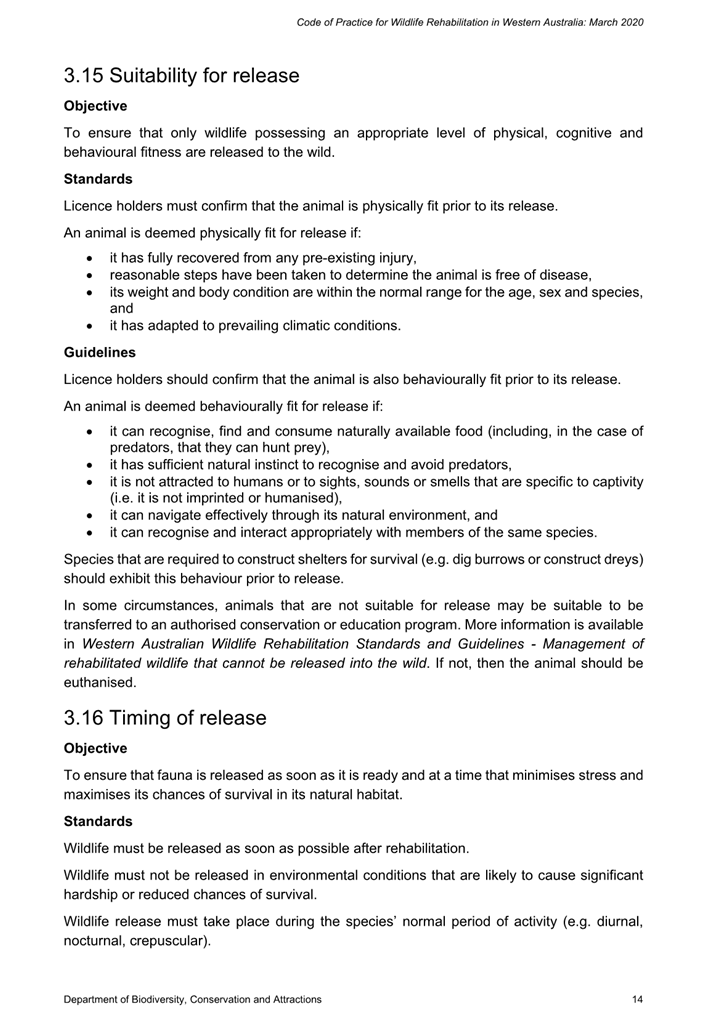
The Australia New Zealand Food Standards Code prohibits live animals in areas where food is handled.
Cooked and ready to eat food is handled, stored and served to Council Members and Officers for consumption in the Jarrah Dining Room.
The presence of marsupials in the Jarrah Dining Room while food is being handled creates an offence under this legislation. |
|
2. Workplace Disruption |
Joeys in care do not roam freely, make noise, or interact with staff.
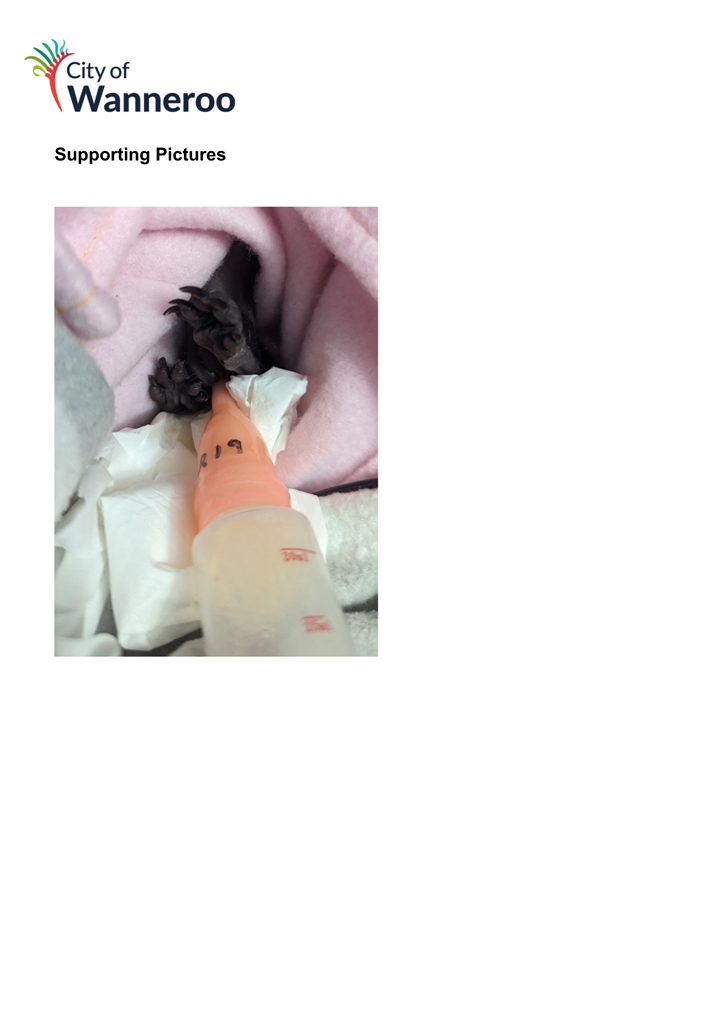
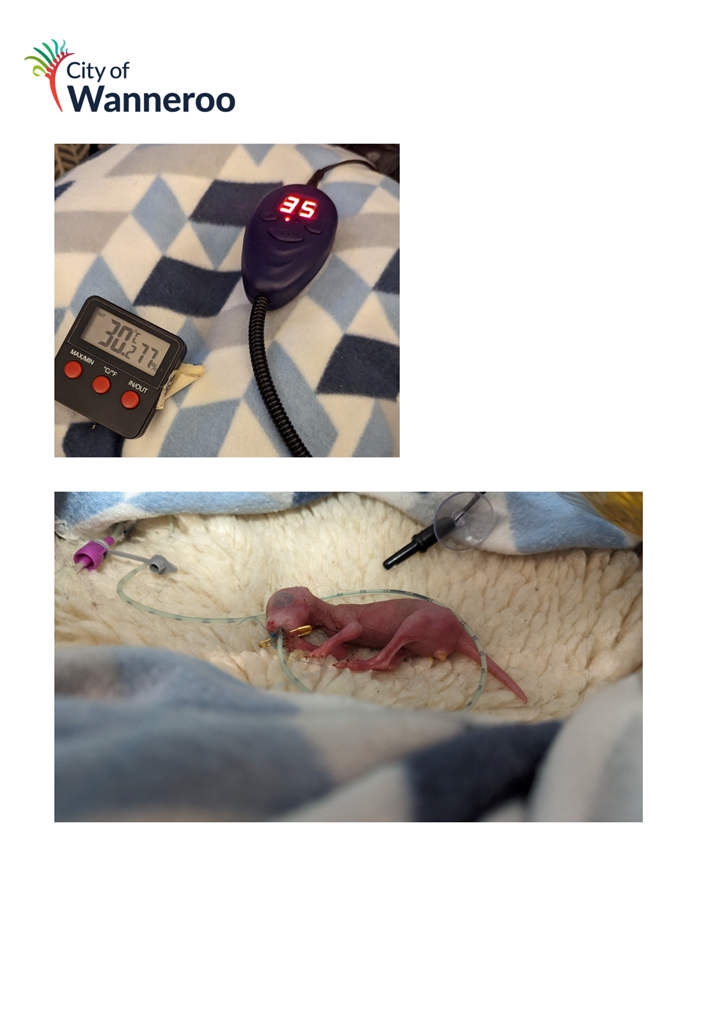
They remain in secure, self-contained pouches under a desk or chair, much like therapy or assistance animals already permitted in workplaces. They are in special pods that require a heat source and monitoring 24 hrs by the carer until the Joey reaches 1kg. Pods must be within eye range of the carer. Their feeding schedule is minimal and does not interfere with work duties. |
The admission of marsupials to the Civic Centre may contravene the Council Members, Committee Members, and Candidates Code of Conduct, which requires maintaining a harmonious, safe, and productive work environment as indicated above.
Consideration needs to be given to City staff that are required to attend meetings and that have not been consulted, nor given the opportunity to decline attendance on the basis of the marsupial presence. |
|
3. Hygiene and Cleaning Costs |
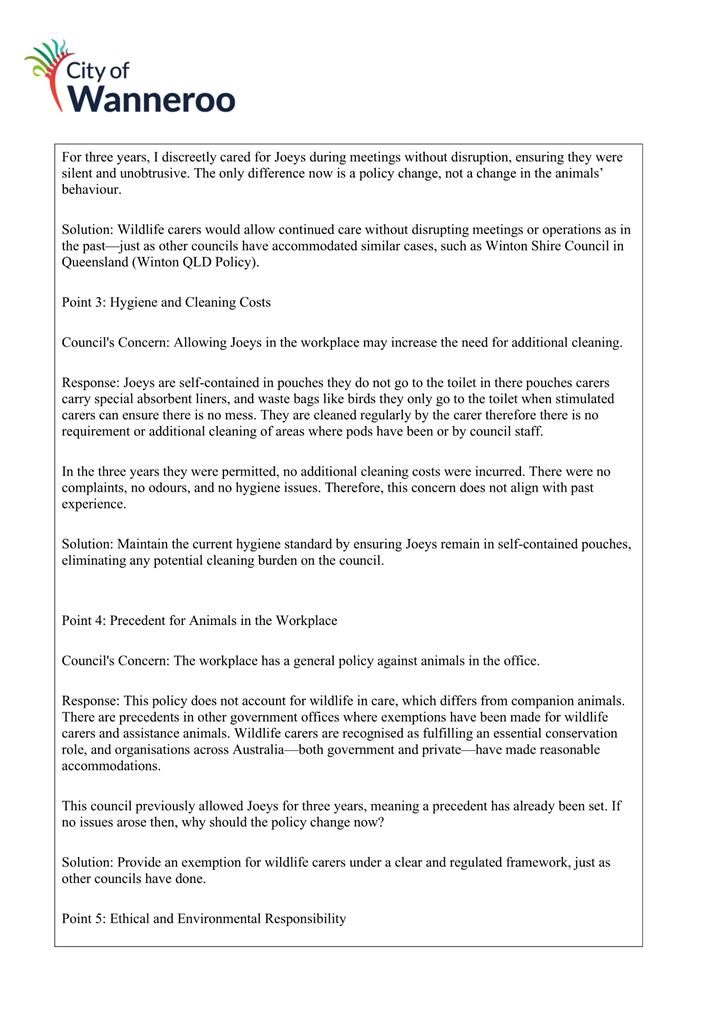
Joeys are self-contained in pouches they do not go to the toilet in there pouches carers carry special absorbent liners, and waste bags like birds they only go to the toilet when stimulated carers can ensure there is no mess. They are cleaned regularly by the carer therefore there is no requirement or additional cleaning of areas where pods have been or by council staff.
In the three years they were permitted, no additional cleaning costs were incurred. There were no complaints, no odours, and no hygiene issues. Therefore, this concern does not align with past experience.
Solution: Maintain the current hygiene standard by ensuring Joeys remain in self-contained pouches, eliminating any potential cleaning burden on the council. |
Whilst it is acknowledged that no additional cleans have needed to occur previously, should additional cleaning be required for a future incident, it is anticipated that costs of around $600 would be required for any additional cleaning on each occurrence.
The $600 cleaning fee is an estimate derived from the City's standard contract rates, designed to address various potential cleaning needs. This includes costs for assessing contamination, thorough disinfection and sanitisation, odour elimination, and biological waste disposal. While the 200g animal seems small, these procedures are necessary to mitigate potential biohazards. The final cost may fluctuate based on the specific cleaning requirements encountered. |
|
4. Precedent for Animals in the Workplace |
This policy does not account for wildlife in care, which differs from companion animals. There are precedents in other government offices where exemptions have been made for wildlife carers and assistance animals. Wildlife carers are recognised as fulfilling an essential conservation role, and organisations across Australia—both government and private—have made reasonable accommodations.
This council previously allowed Joeys for three years, meaning a precedent has already been set. If no issues arose then, why should the policy change now?
Solution: Provide an exemption for wildlife carers under a clear and regulated framework, just as other councils have done. |
Assistance Animals
There are exemptions for assistance animals are under the Disability Discrimination Act 1992. For the purpose of this Act an assistance animal is:
• accredited under a law of a State or Territory that provides for the accreditation of animals trained to assist a persons with a disability to alleviate the effect of the disability; or • accredited by an animal training organisation prescribed by the regulations for the purposes of this paragraph; or • trained: o to assist a person with a disability to alleviate the effect of the disability; and o to meet standards of hygiene and behaviour that are appropriate for an animal in a public place.
The animals applied for under this licence would not meet these criteria.
In terms of exemptions for wildlife carers, there would need an amendment to the Public Places and Local Government Local Law to allow this. This local law is currently being reviewed.
Precedent for Animals in the Workplace
Administration’s understanding is that it was an individual decision taken by the previous Mayor not to challenge the kangaroos being brought into the Council premise. Administration is not aware that permission to do so was ever sought or granted, so no organisational ‘precedent’ has been set.
Anecdotally Administration is aware of Civic Centre staff making informal complaints about live animals being admitted to the workplace at the time, though the then-Mayor’s decision was respected and no formal staff complaint was documented to Administrations knowledge. |
|
5. Ethical and Environmental Responsibility |
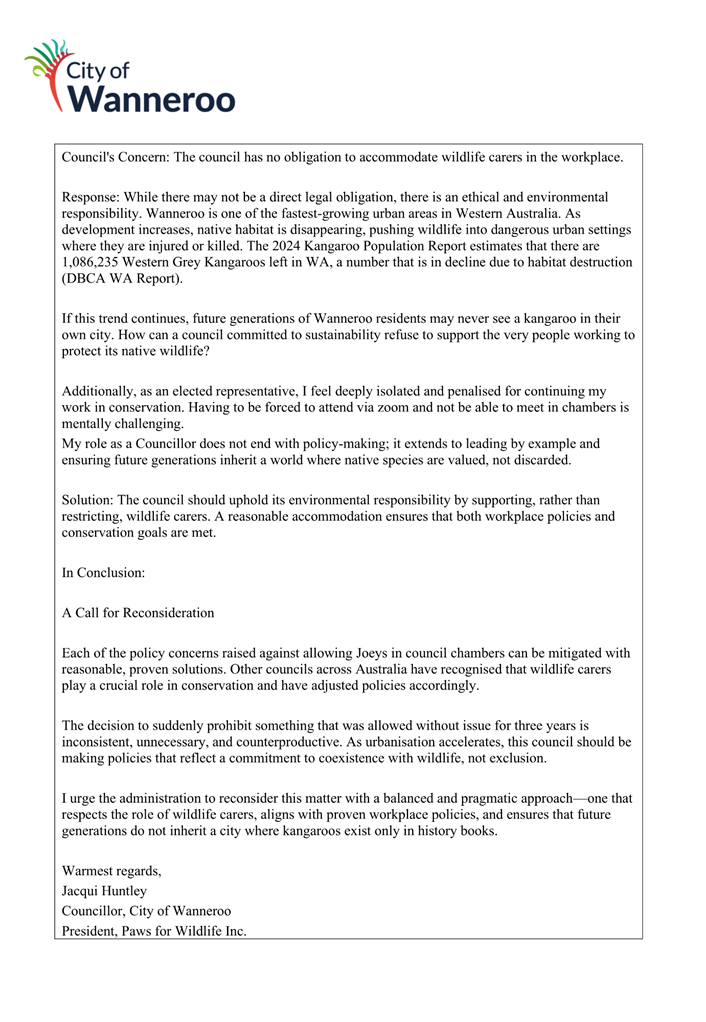
While there may not be a direct legal obligation, there is an ethical and environmental responsibility. Wanneroo is one of the fastest-growing urban areas in Western Australia. As development increases, native habitat is disappearing, pushing wildlife into dangerous urban settings where they are injured or killed. The 2024 Kangaroo Population Report estimates that there are 1,086,235 Western Grey Kangaroos left in WA, a number that is in decline due to habitat destruction (DBCA WA Report).
If this trend continues, future generations of Wanneroo residents may never see a kangaroo in their own city. How can a council committed to sustainability refuse to support the very people working to protect its native wildlife?
Additionally, as an elected representative, I feel deeply isolated and penalised for continuing my work in conservation. Having to be forced to attend via zoom and not be able to meet in chambers is mentally challenging.
My role as a Councillor does not end with policy-making; it extends to leading by example and ensuring future generations inherit a world where native species are valued, not discarded.
Solution: The council should uphold its environmental responsibility by supporting, rather than restricting, wildlife carers. A reasonable accommodation ensures that both workplace policies and conservation goals are met. |
The application did not meet the necessary requirements as outlined in the relevant policies and guidelines.
The Act the Role of Council under section 2.7 as:
“2.7. Role of council
(1) The council governs the local government’s affairs and, as the local government’s governing body, is responsible for the performance of the local government’s functions. (2) The council’s governing role includes the following — (a) overseeing the allocation of the local government’s finances and resources; (b) determining the local government’s policies; (c) planning strategically for the future of the district; (d) determining the services and facilities to be provided by the local government in the district; (e) selecting the CEO and reviewing the CEO’s performance; (f) providing strategic direction to the CEO.”
While “determining the local government’s policies” and “planning strategically for the future of the district” can be interpreted to include having consideration at the strategic level for the natural environment, none of these roles creates an “ethical and environmental responsibility” to give wild animals refuge in Council premises. |
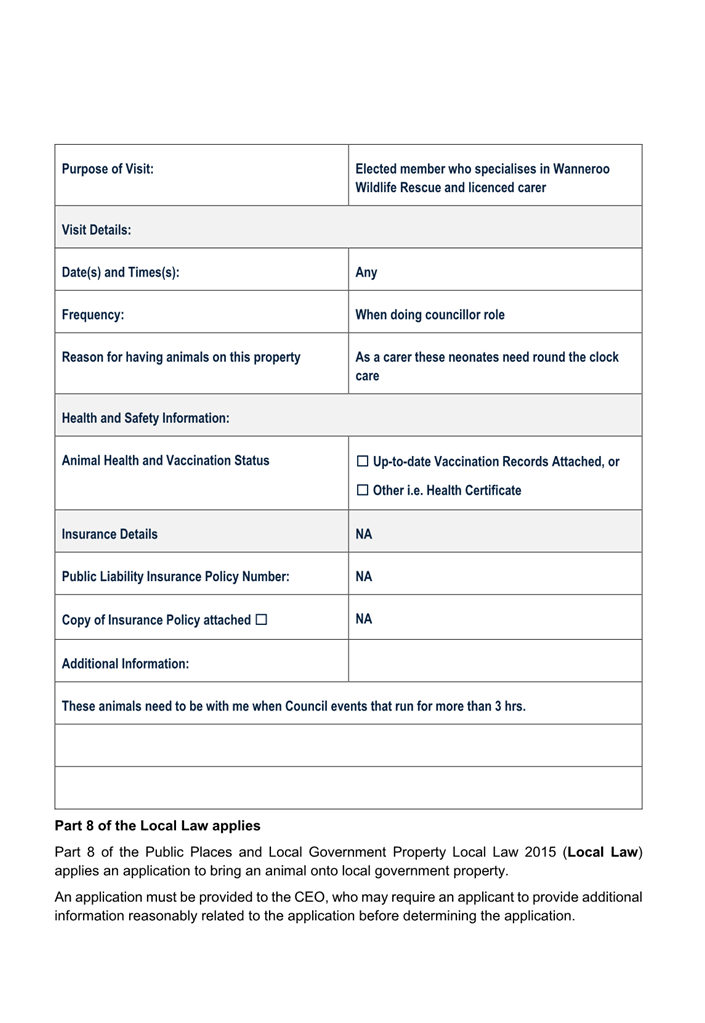
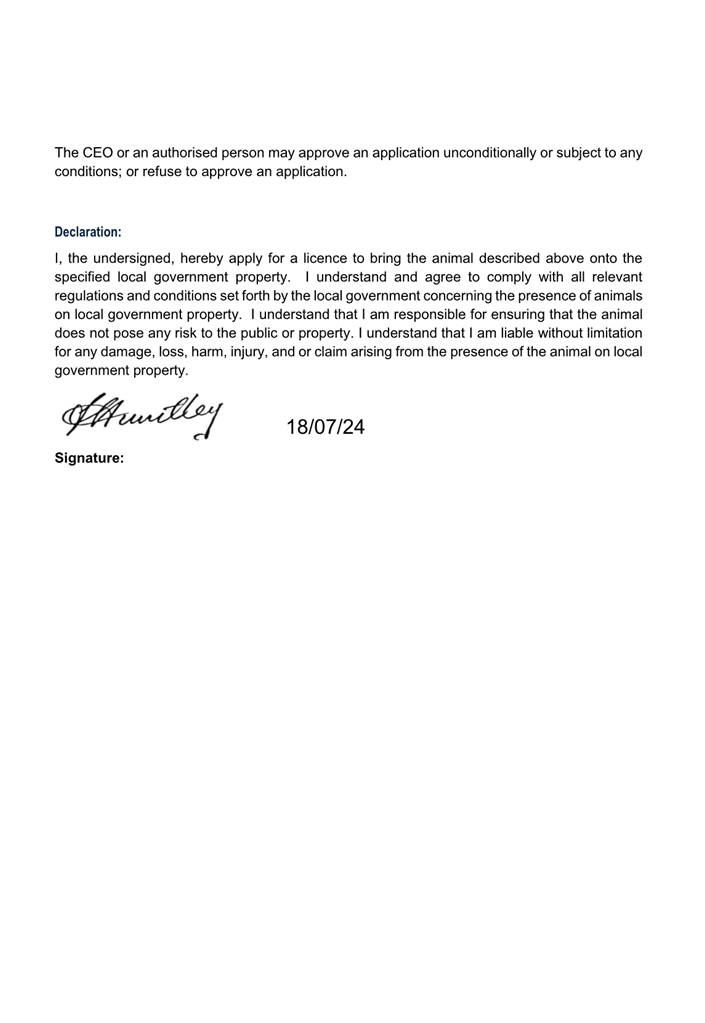
2. Additional Attachment 2 – Licence application form.
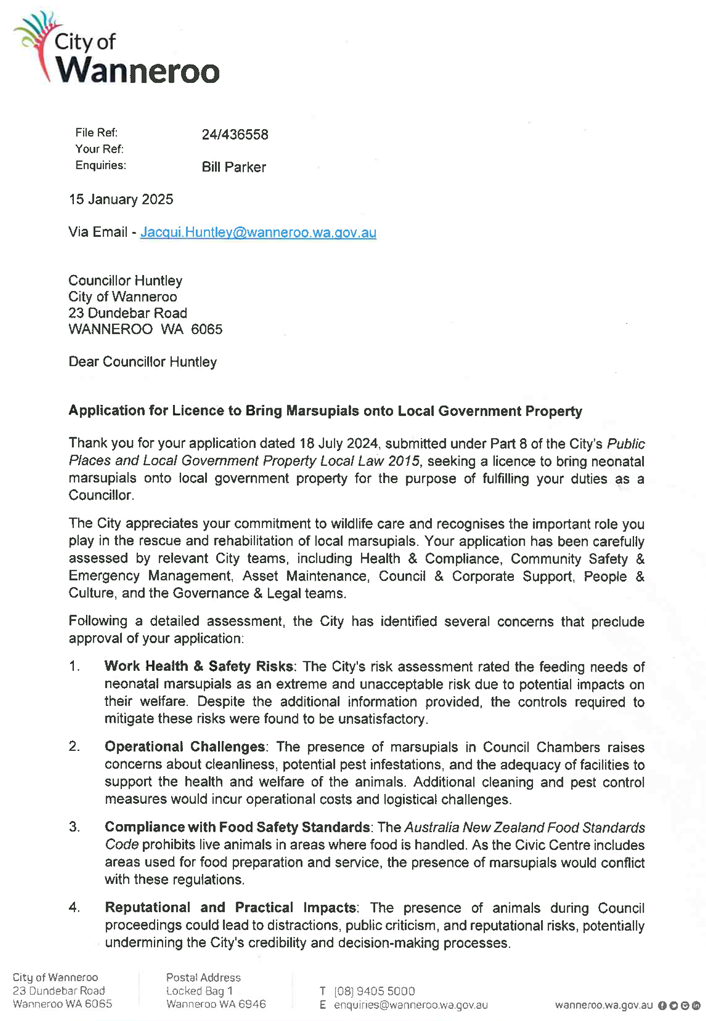
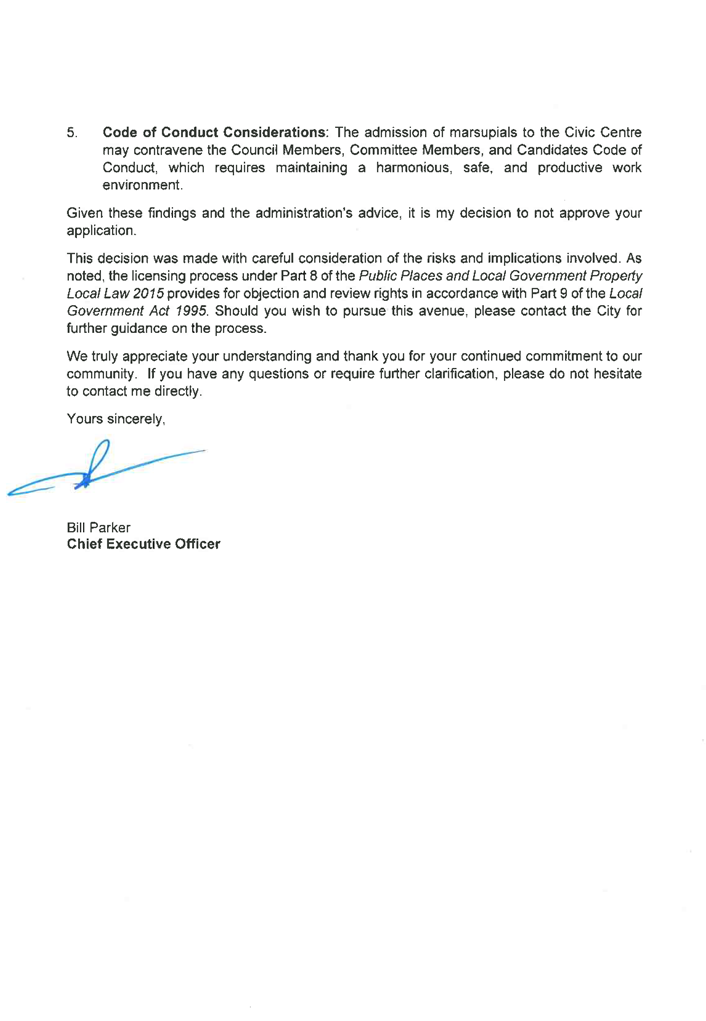
3. Additional Attachment 3 – City’s refusal notification.
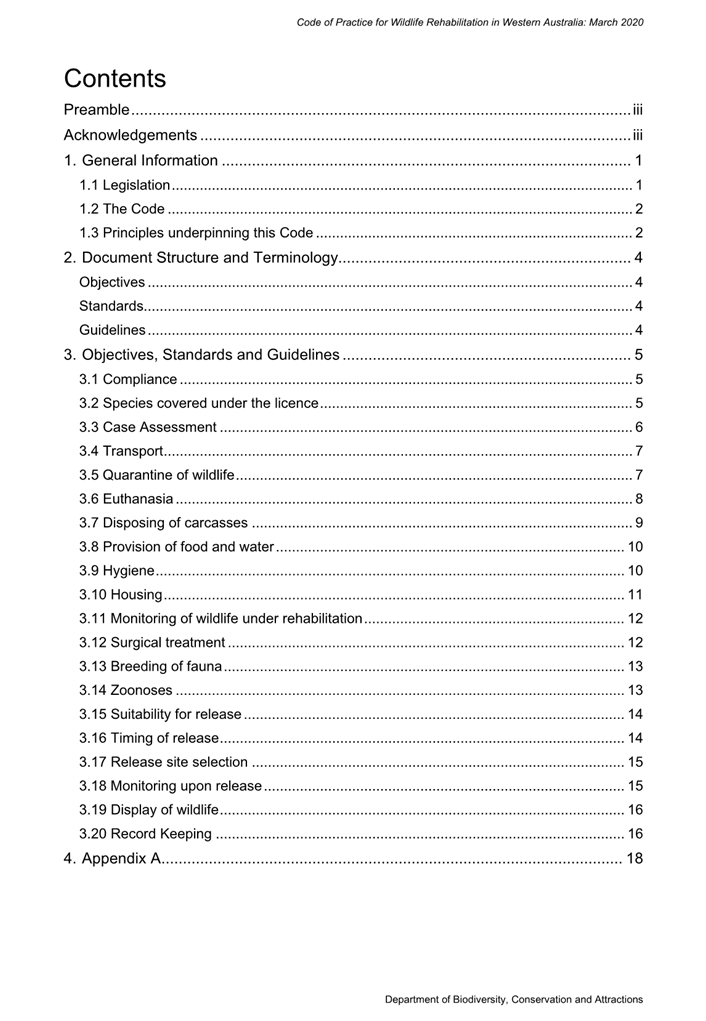
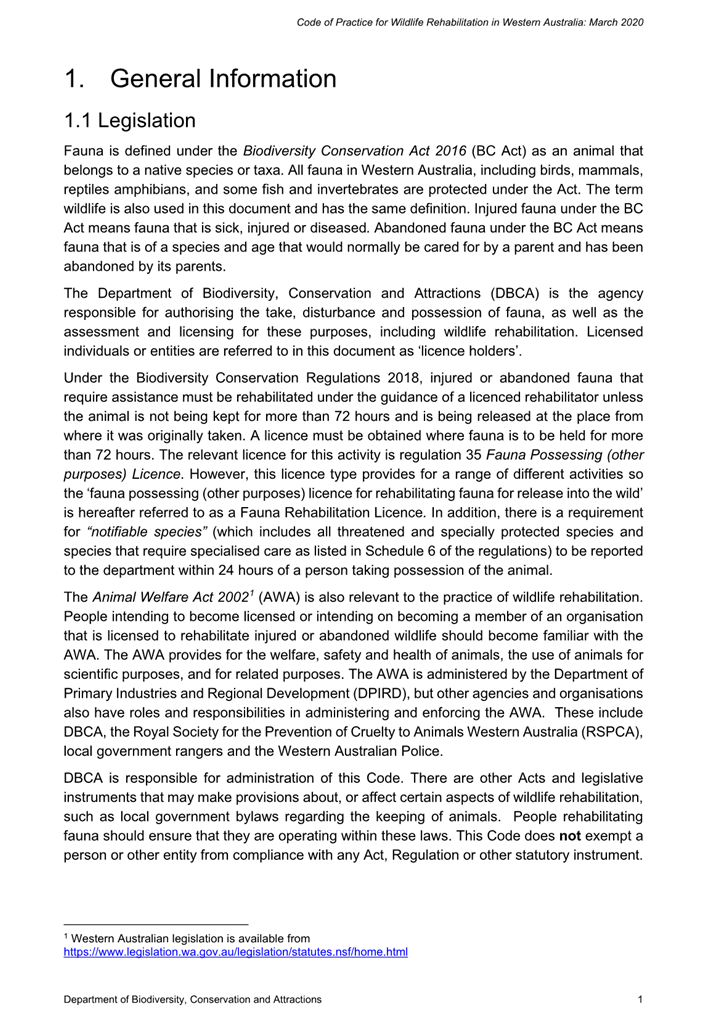
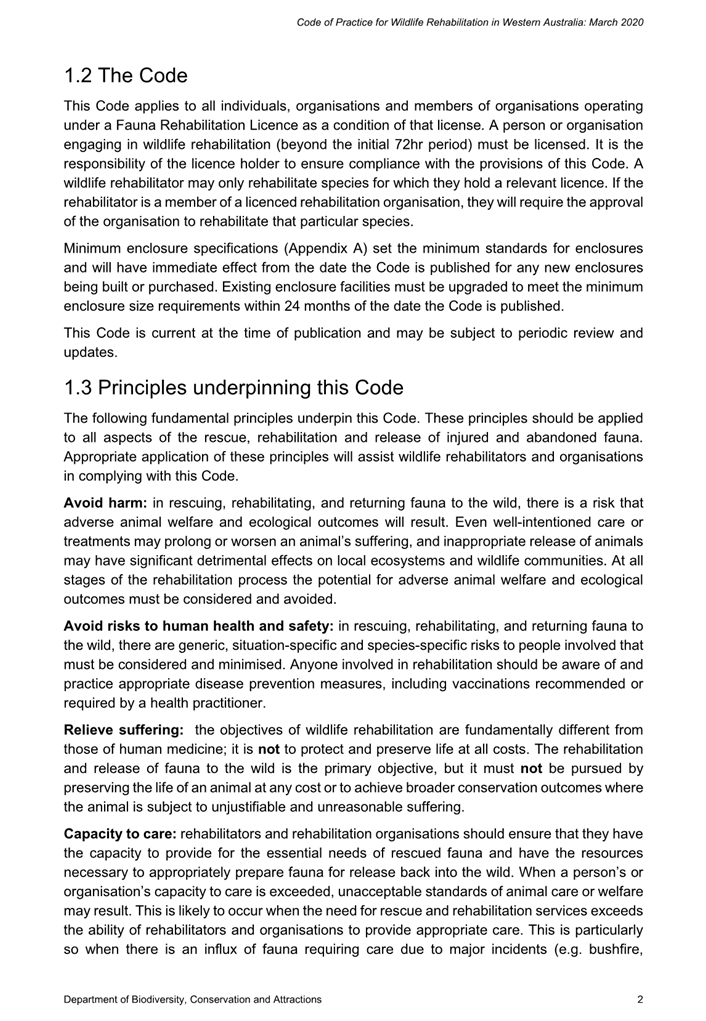
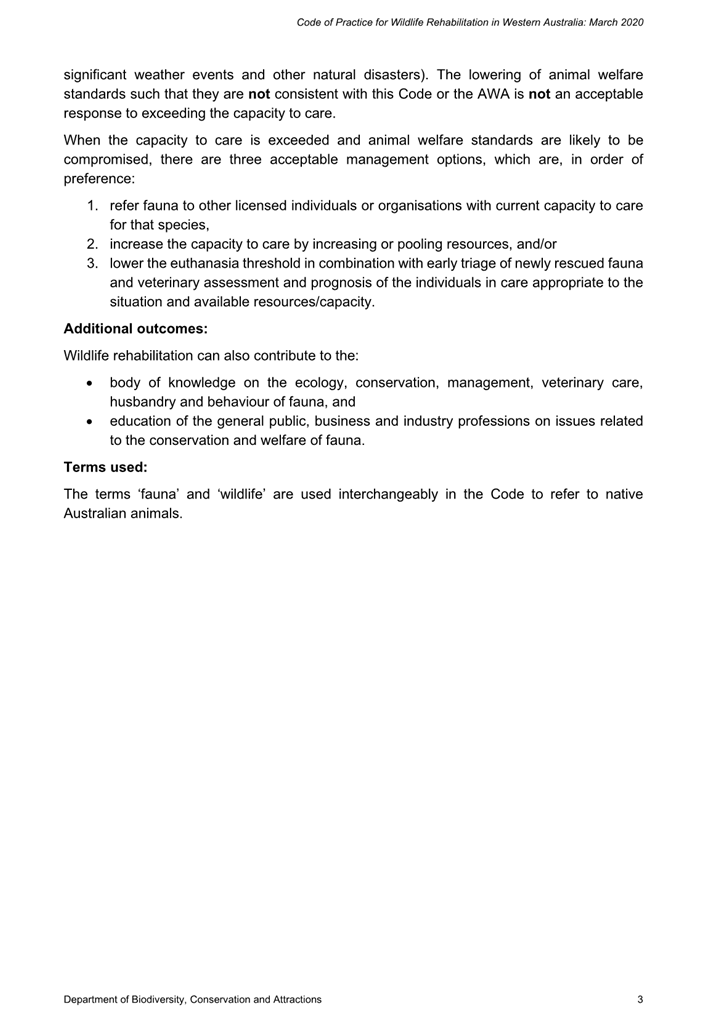
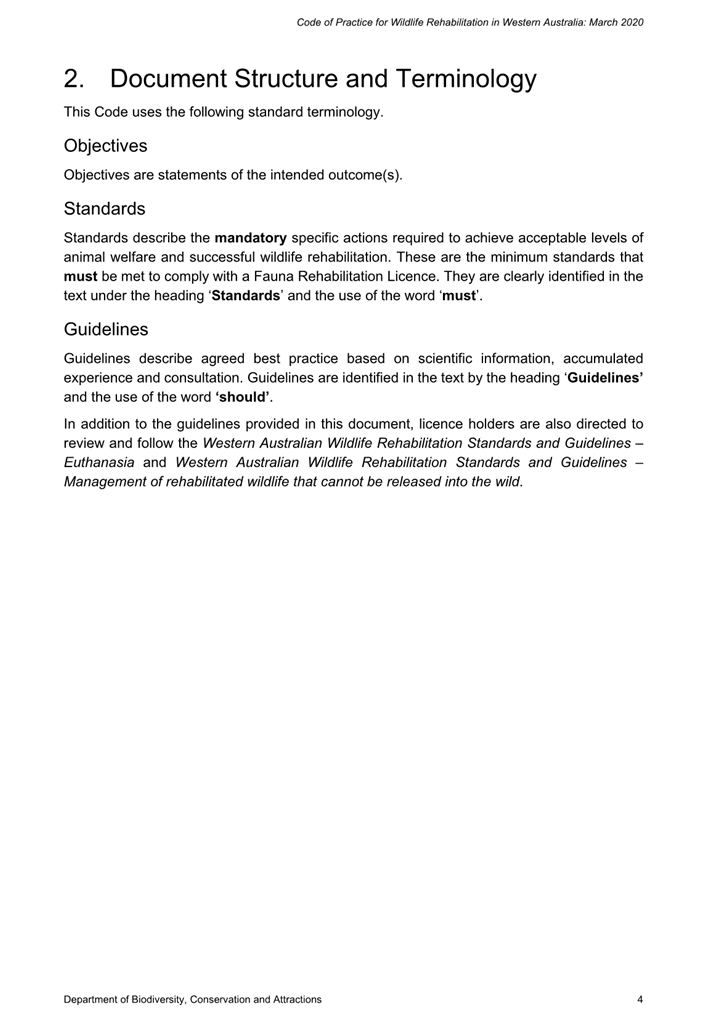
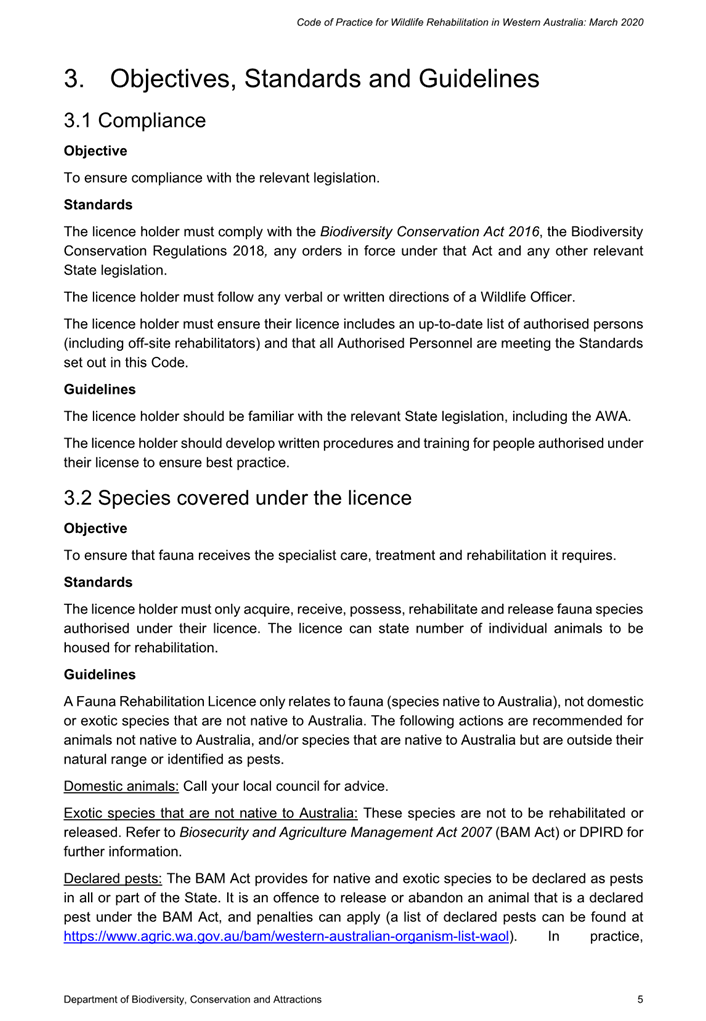
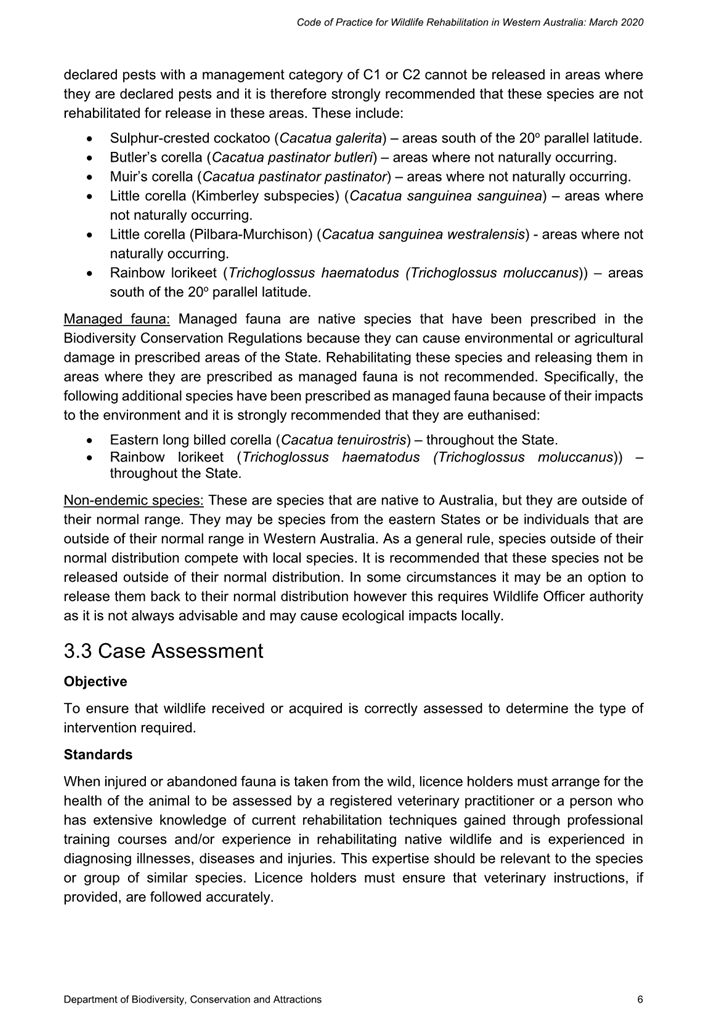
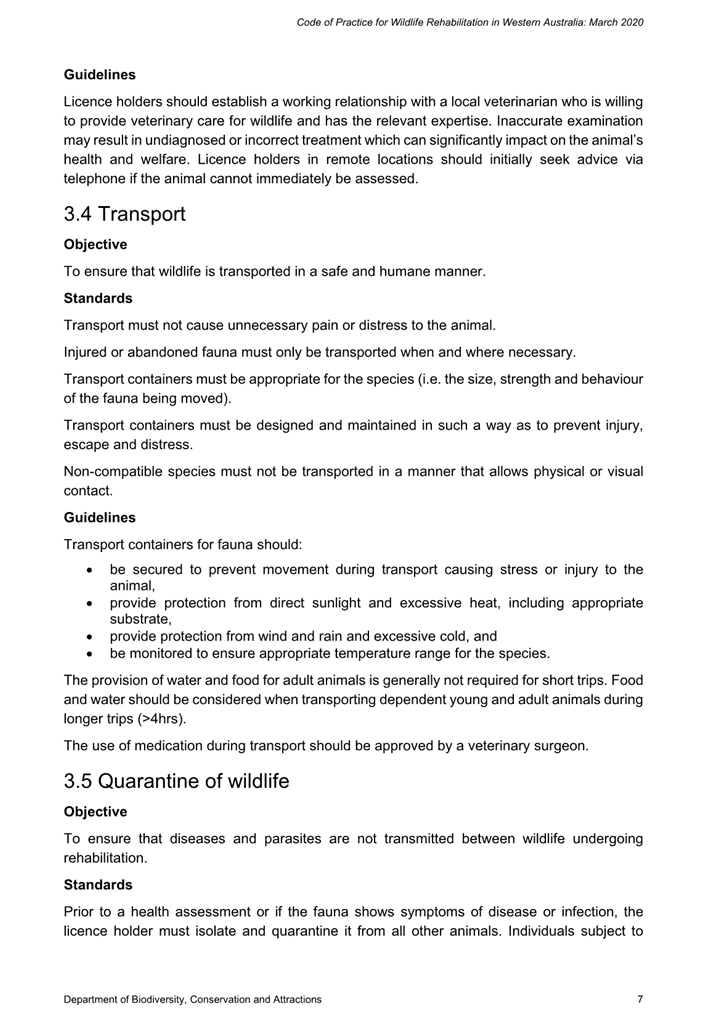
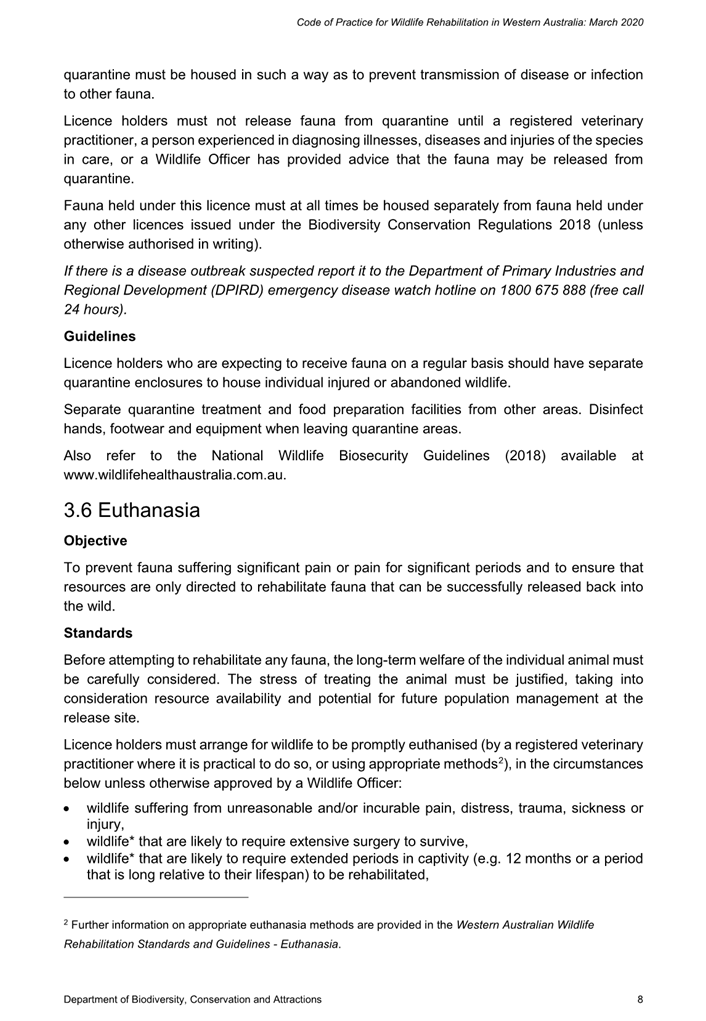
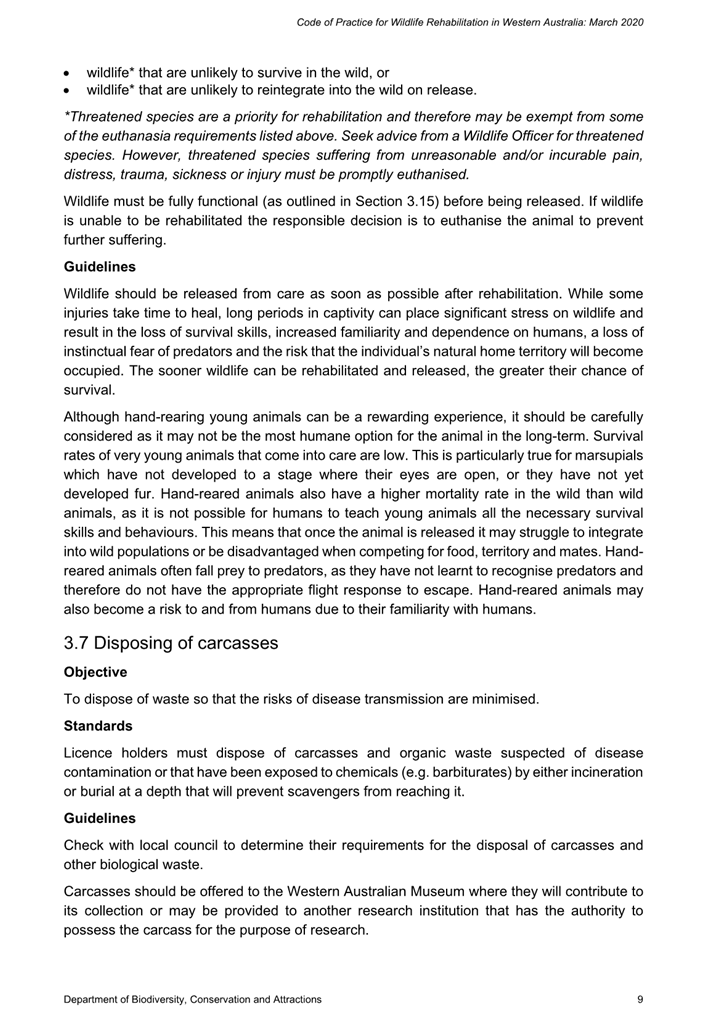
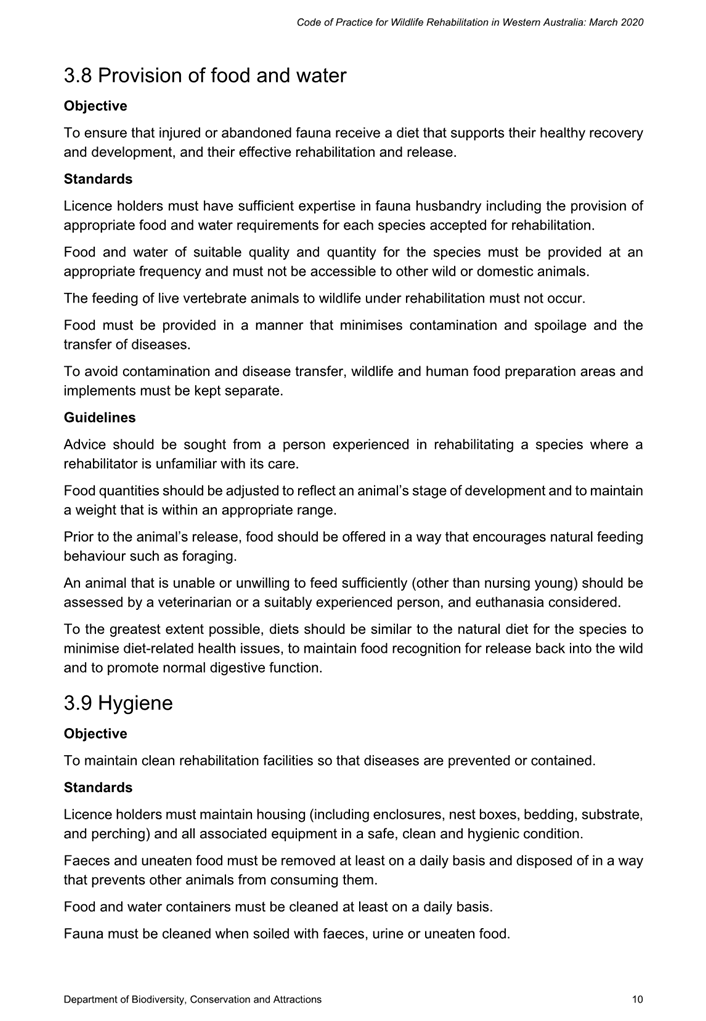
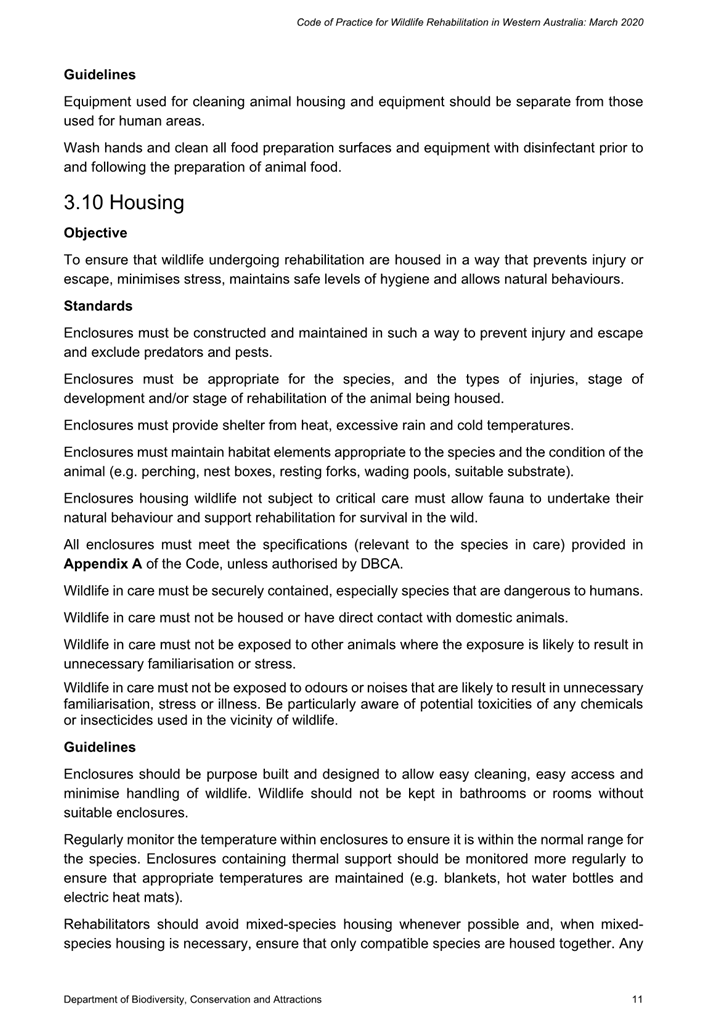
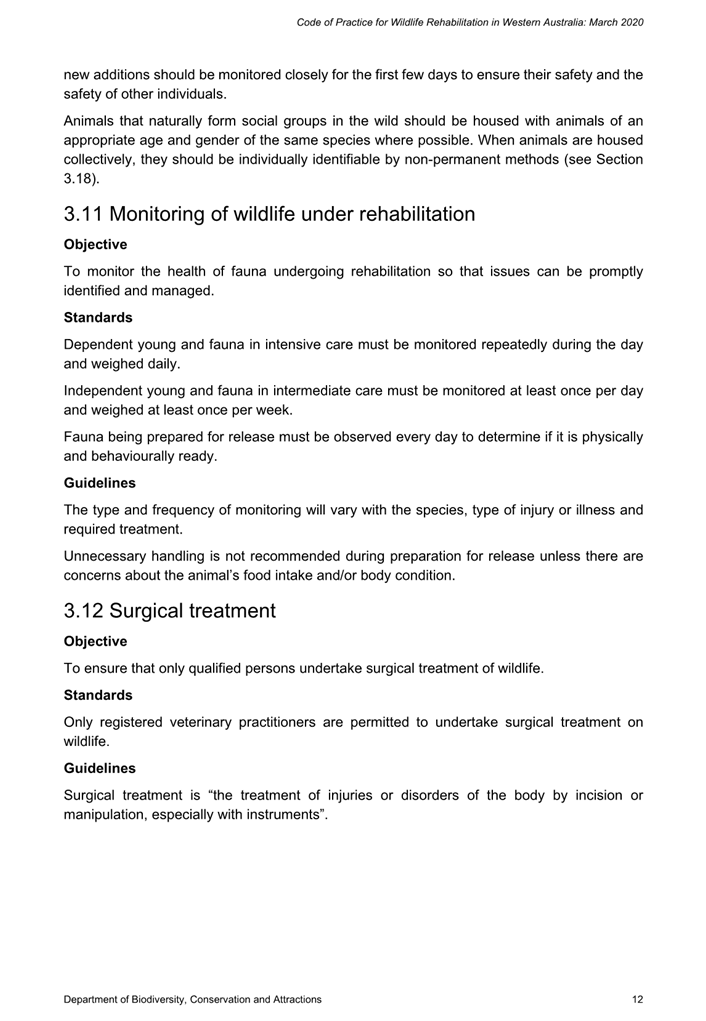
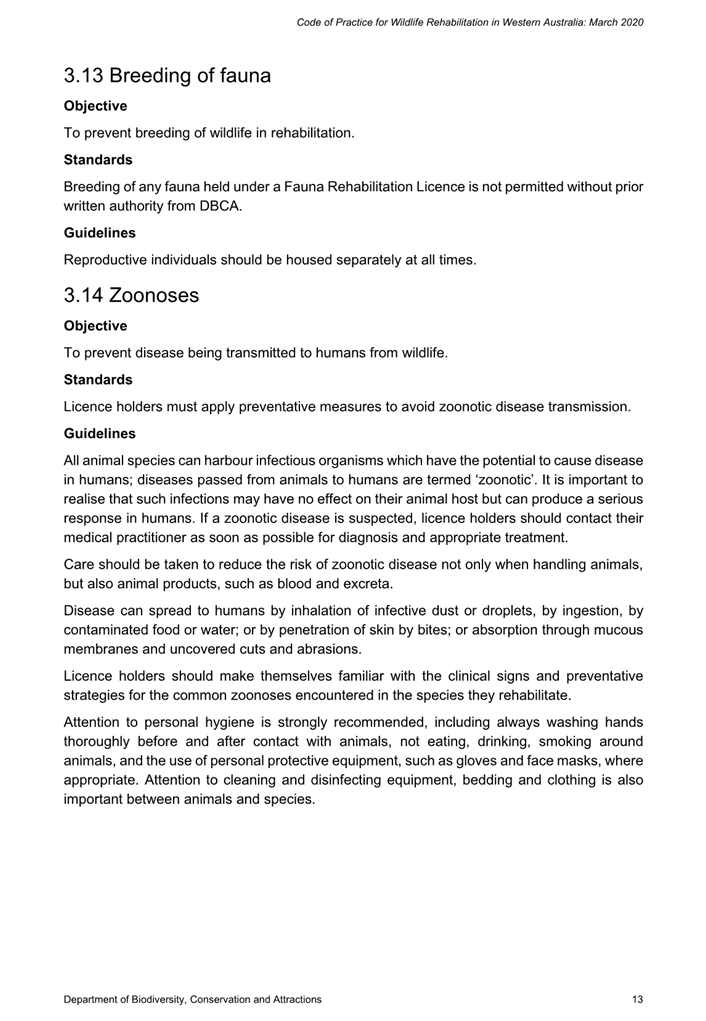
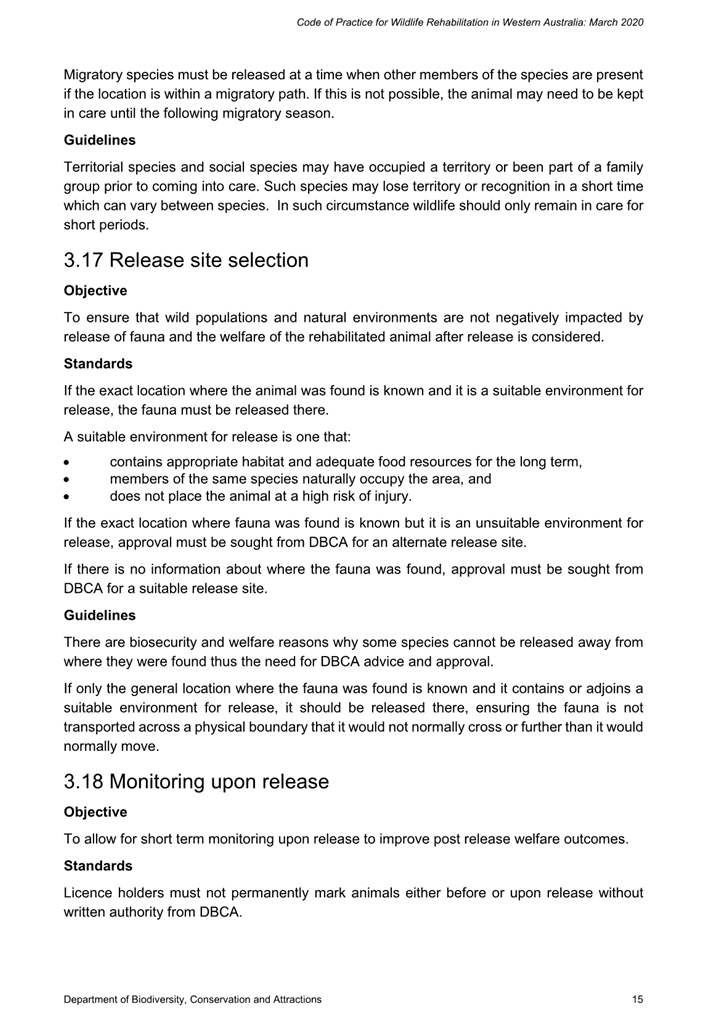
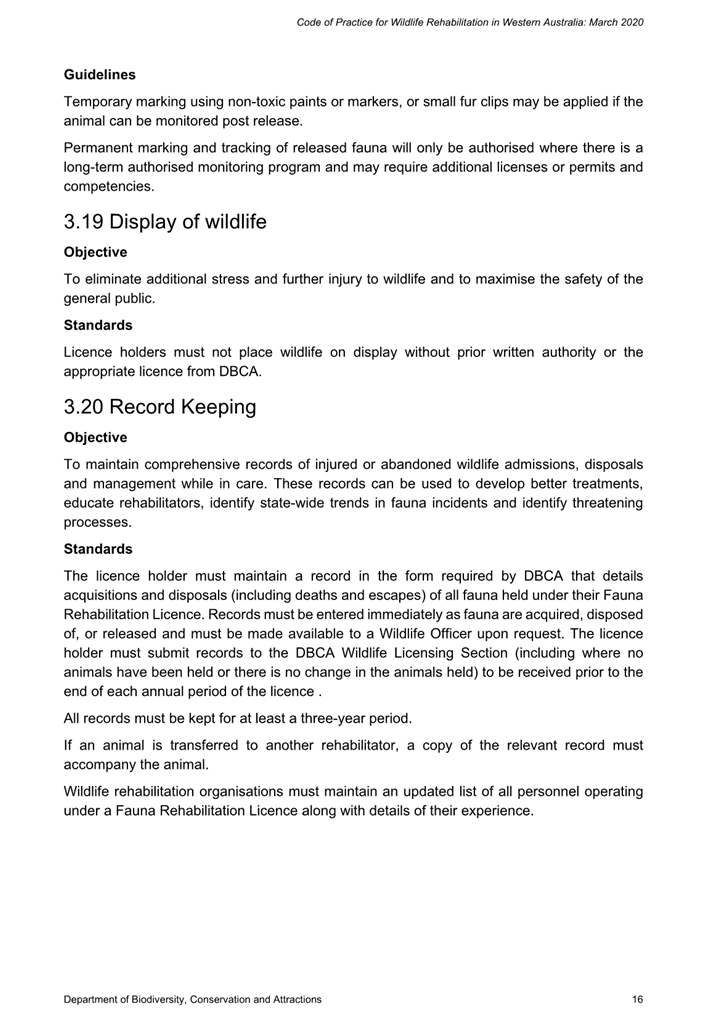
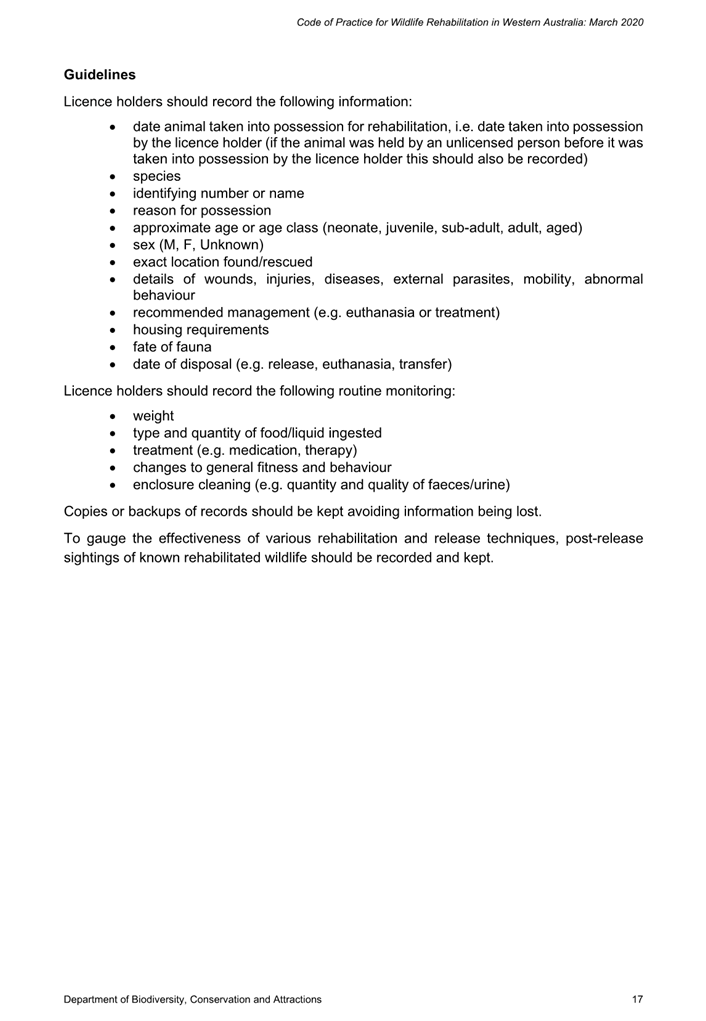
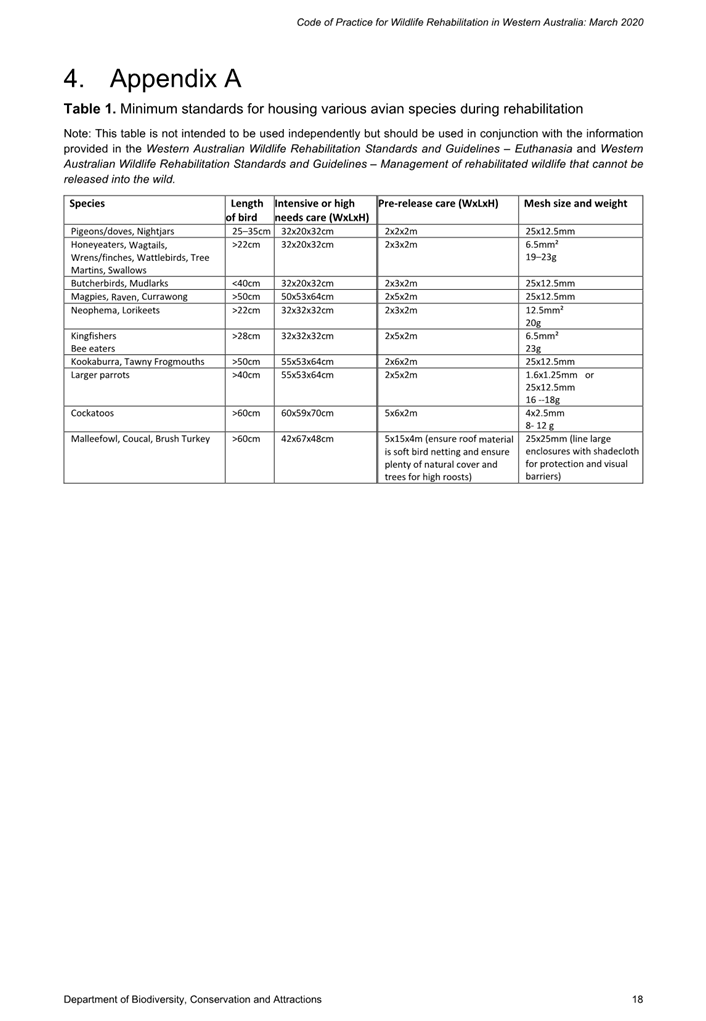
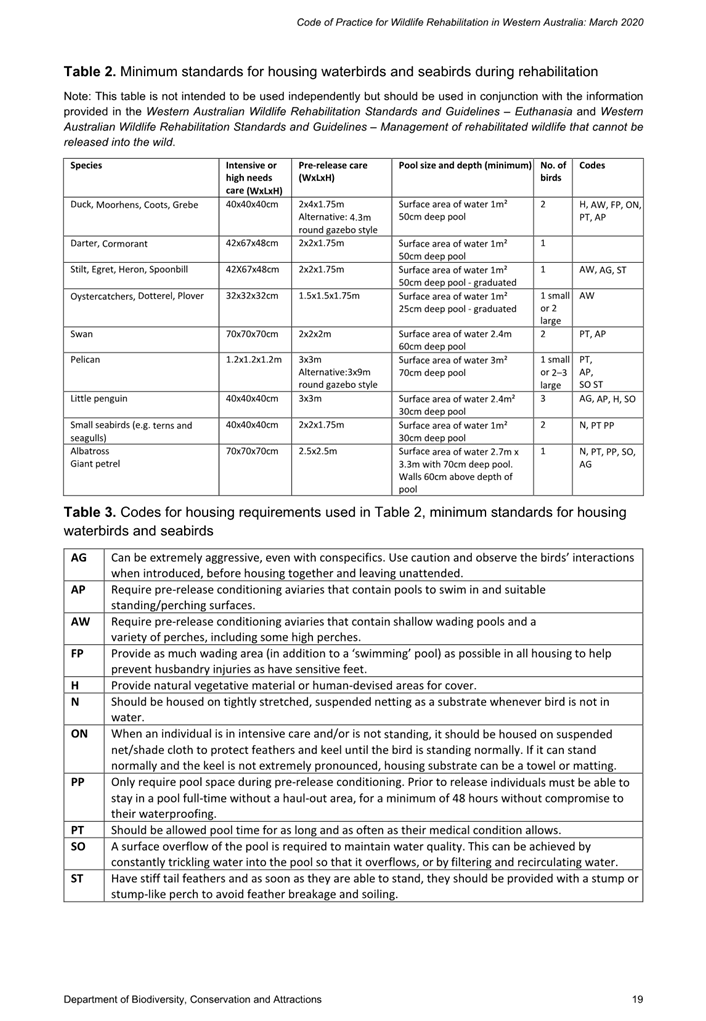
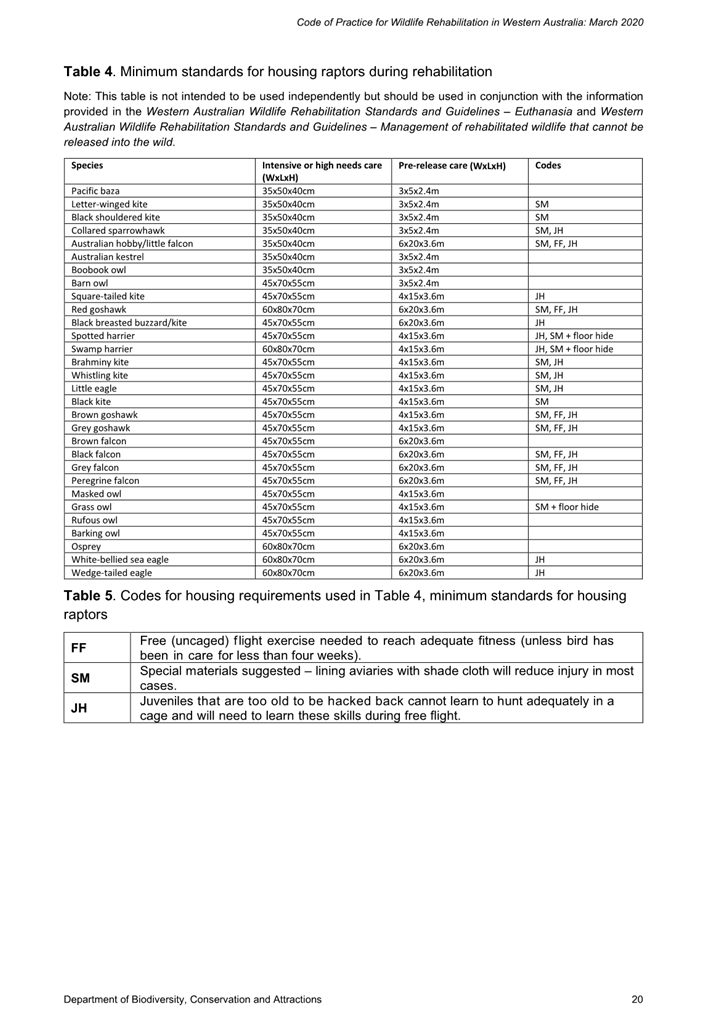
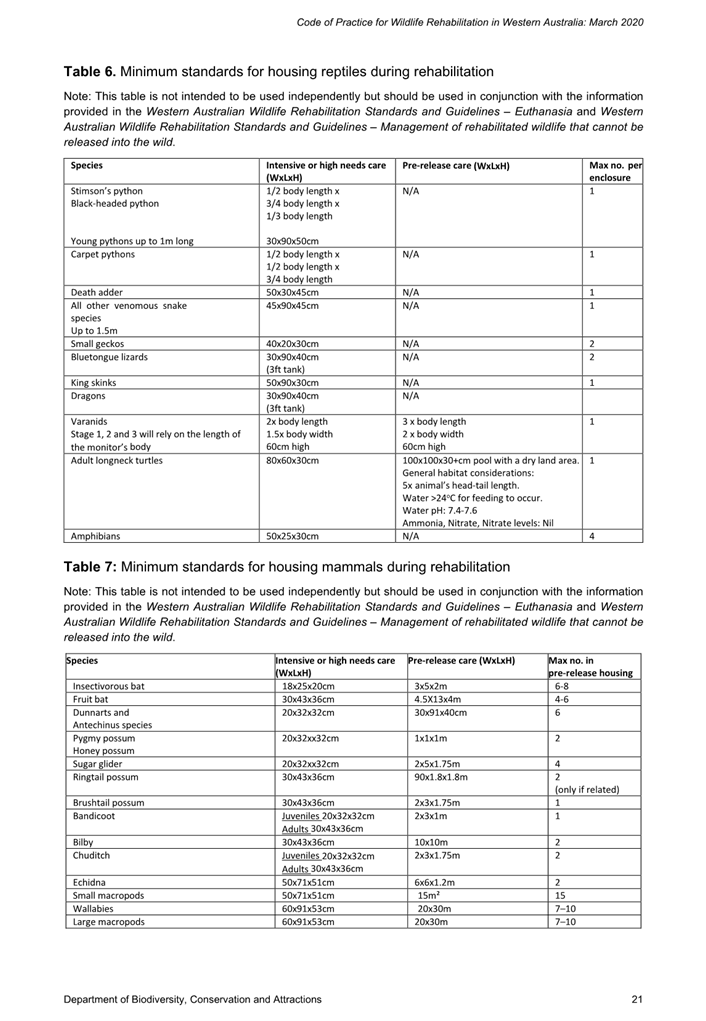
4. Additional Attachment 4 – Department of Biodiversity, Conversation and Attractions (DBCA) Code of Practice for Wildlife Rehabilitation in Western Australia.
5. When consulted DBCA advised there is a condition included on most rehabilitation licences, 5(c), allowing fauna to be transported that requires more intensive care but requires the land managers consent to bring the animal onto site:
“5. Unless otherwise authorised, fauna held under this licence can only be temporarily cared for at a location other than the Property location/s (Licensed Premises) listed on the licence if the fauna:
a) is contained securely at all times, except when under the control of the licence holder;
b) is not intentionally on display to the public (unless authorised by the CEO); and
c) is receiving care at a registered veterinary practice or is away from the Licensed Premise for no longer than 6 hours for essential care, training, or transfer to another Licensed Premises for rehabilitation purposes.”
6. When contacted the RSPCA advised the relevant agency to assist with queries around Joey care was the DBCA.
Issue
For Council to consider an objection to a refusal of licence to bring neonatal marsupials onto local government property.
Background
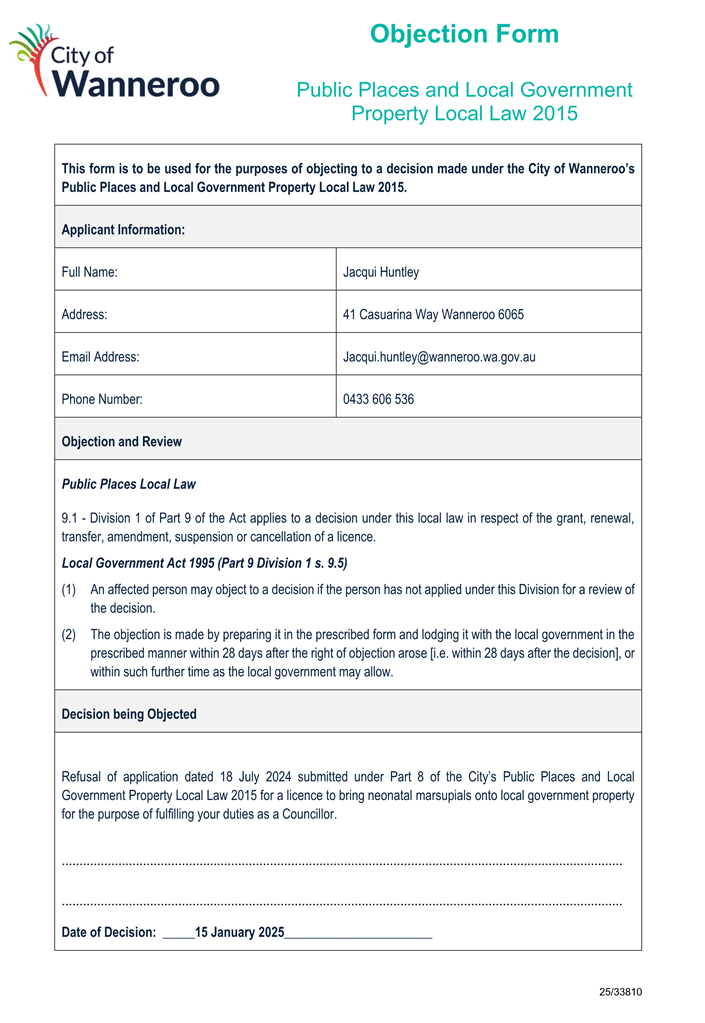
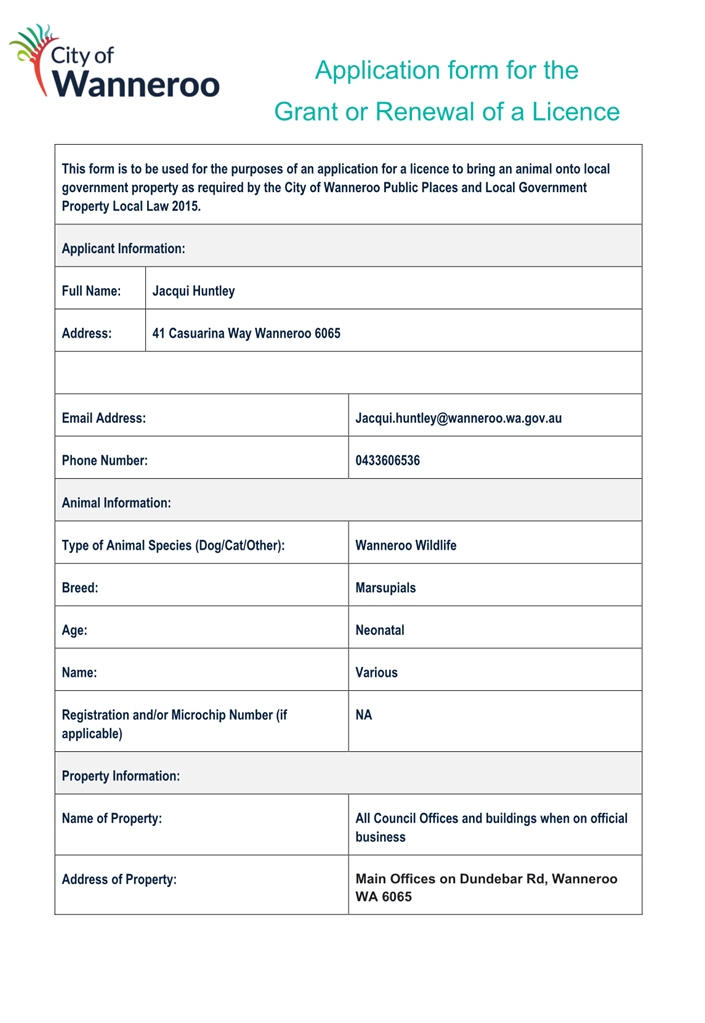
Cr Jacqueline Huntley lodged an application dated 18 July 2024 with the City of Wanneroo (the City) under Part 8 of the City’s Public Places and Local Government Property Local Law 2015, seeking a licence to bring neonatal marsupials onto local government property for the purpose of fulfilling her duties as a Councillor.
Administration conducted a risk assessment, performed due diligence, and consulted relevant agencies, including WA Wildlife and the Department of Biodiversity, Conservation and Attractions (DBCA) Wildlife Protection Branch, as part of the licence application assessment process.
Detail
The application was given careful consideration and assessed by relevant City teams, including Health and Compliance, Community, Safety & Emergency Management, Asset Maintenance, Council and Corporate Support, People & Culture and Legal & Governance.
Following the detailed assessment, the City identified several concerns that preclude approval of the application:
1. Work Health & Safety Risks for Animals: The City's risk assessment rated the feeding needs of neonatal marsupials as an extreme and unacceptable risk due to potential impacts on their welfare. Despite the additional information provided, the controls required to mitigate these risks were found to be unsatisfactory.
2. Work Health & Safety Risks for City Staff & Council Members: The presence of marsupials poses a Work Health & Safety risk to City staff and Council Members in respect of potential injuries or hazards due to unrestrained animals, unknown or known allergies and hygiene related concerns (such as odour).
3. Operational Challenges: The presence of marsupials in Council Chambers raises concerns about cleanliness, potential pest infestations, and the adequacy of facilities to support the health and welfare of the animals. Additional cleaning and pest control measures would incur operational costs and logistical challenges.
Whilst it is acknowledged that no additional cleans have needed to occur previously, should additional cleaning be required for a future incident, it is anticipated that costs of around $600 would be required for any additional cleaning on each occasion.
4. Compliance with Food Safety Standards: The Australia New Zealand Food Standards Code prohibits live animals in areas where food is handled. As the Civic Centre includes areas used for food preparation and service, the presence of marsupials would conflict with these regulations.
5. Reputational and Practical Impacts: The presence of animals during Council proceedings could lead to distractions, public criticism, and reputational risks, potentially undermining the City's credibility and decision-making processes.
6. Code of Conduct Considerations: The admission of marsupials to the Civic Centre may contravene the Council Members, Committee Members, and Candidates Code of Conduct, which requires maintaining a harmonious, safe, and productive work environment as indicated above.
Consideration has not been given to City staff that are required to attend meetings and that have not been consulted, nor given the opportunity to decline attendance on the basis of the marsupial presence.
7. Carrying Out Non-Council Related Duties While Exercising the Role of Council Member:
Under section 2.10 of the Local Government Act 1995 (the Act) the role of Councillors is defined as:
“2.10. Role of councillors
(1) A councillor —
(a) represents the interests of the electors, ratepayers and residents of the district and takes account of the interests of other persons who work in, or visit, the district; and
(b) participates in the deliberation and decision-making of the local government at council and committee meetings; and
(c) facilitates communication with the community about council decisions; and
(d) facilitates and maintains good working relationships with other councillors, the mayor or president and the CEO; and
(e) acts consistently with section 2.7(3) to (5); and
(f) maintains and develops the requisite skills to effectively perform their role.”
By allowing Council Members to carryout out their duties within their personal or professional capacity while representing the City of Wanneroo and making decisions as a Council Member decreases the degree of separation between a Council Member’s duties as a member of council and their personal endeavours.
Issuing this license will determine precedence in allowing all Council Members to carryout personal pursuits while acting in the capacity of a Council Member.
The City values Cr Huntley’s dedication to wildlife care and acknowledges her vital role in the rescuing and rehabilitating local marsupials. However, after a comprehensive assessment of the associated risks and implications, and considering the Administration's findings and advice, the application was not approved. Cr Huntley was formally notified in writing of this decision on 15 January 2025.
Cr Huntley was also informed that the licensing process under Part 8 of the Public Places and Local Government Property Local Law 2015 provides for objection and review rights in accordance with Part 9 of the Act.
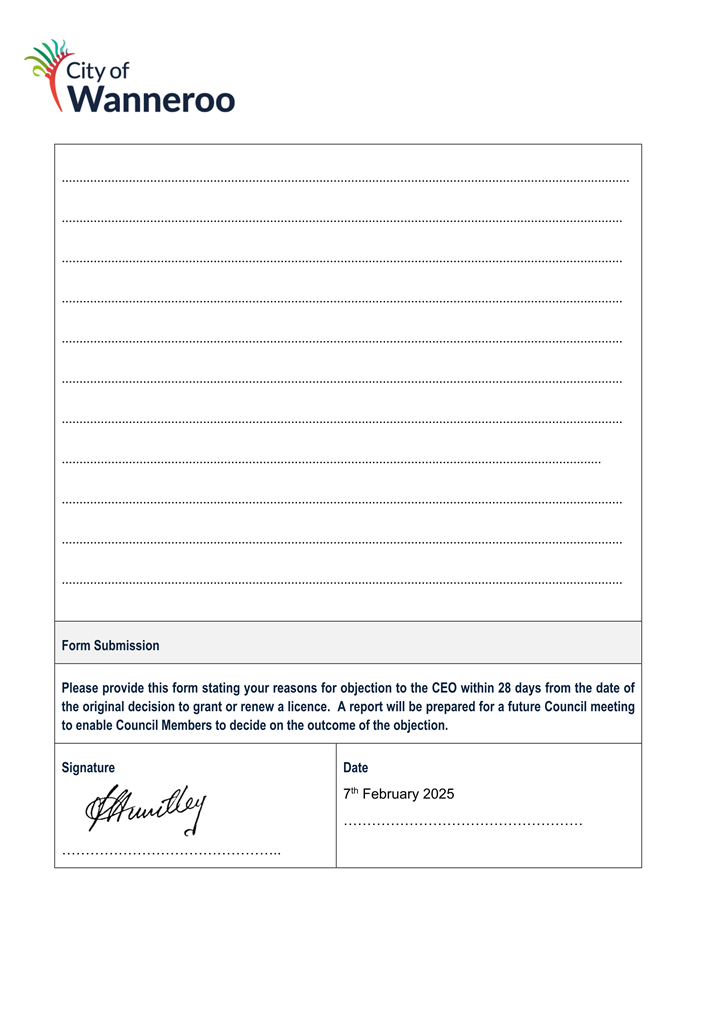
The City received Cr Huntley’s objection to the decision on 7 February 2025. Council is now required to consider this objection (Attachment 1) in accordance with Part 9, Division 1, Section 9.5 of the Act, as it pertains to the administration’s decision to refuse her licence application.
Consultation
The application was thoroughly reviewed and assessed through a collaborative process involving the relevant City teams, including Health and Compliance, Community Safety & Emergency Management, Asset Maintenance, Council and Corporate Support, People & Culture, and Legal & Governance.
Comment
By submitting the objection form to the Chief Executive Officer, Cr Huntley is formally requesting that Council review her objection to Administration’s decision not to approve her licence application.
In her objection, Cr Huntley contends that the decision was based on factors that were either misinterpreted, unfairly applied, or not adequately considered. Specifically, she asserts that:
· The assessment criteria used to reject the application were not applied consistently or transparently.
· Relevant supporting evidence was either overlooked or not given sufficient weight in the decision-making process.
· The rationale provided for the refusal does not align with past precedent or established policies.
Administration has reaffirmed its decision, citing the following reasons:
· The application did not meet the necessary requirements as outlined in the relevant policies and guidelines.
· The decision was made in accordance with legislative and procedural requirements, ensuring fairness and consistency across all applications.
· No new information or justification has been provided that would warrant reconsideration of the initial decision.
Below is a summary of the response from the Cr Huntley and a response from Administration.
|
Objection Point |
Response by Submitter |
Response by Administration |
|
1. Health and Safety Concerns |
Orphaned Joeys in care do not pose health risks. Unlike domestic animals, which may carry zoonotic diseases, Joeys raised in human care are kept in a controlled, sterile environment that mimics the natural antimicrobial properties of a mother’s pouch. Scientific studies confirm that macropods do not transmit diseases to humans in controlled care settings, and hygiene practices for wildlife carers are already aligned with government health and safety standards.
Additionally, for three years (2020–2023), Joeys were allowed in council without a single recorded health or hygiene issue. If there were no problems in the past, why has this suddenly become a concern now?
Solution: Implement a standardised care protocol (e.g., enclosed pouches, designated care space implemented before) to ensure continued compliance with workplace health and safety standards, rather than an outright ban. |
The Australia New Zealand Food Standards Code prohibits live animals in areas where food is handled. |
|
2. Workplace Disruption |
Joeys in care do not roam freely, make noise, or interact with staff.
They remain in secure, self-contained pouches under a desk or chair, much like therapy or assistance animals already permitted in workplaces. They are in special pods that require a heat source and monitoring 24 hrs by the carer until the Joey reaches 1kg. Pods must be within eye range of the carer. Their feeding schedule is minimal and does not interfere with work duties. |
|
|
3. Hygiene and Cleaning Costs |
Joeys are self-contained in pouches they do not go to the toilet in there pouches carers carry special absorbent liners, and waste bags like birds they only go to the toilet when stimulated carers can ensure there is no mess. They are cleaned regularly by the carer therefore there is no requirement or additional cleaning of areas where pods have been or by council staff.
In the three years they were permitted, no additional cleaning costs were incurred. There were no complaints, no odours, and no hygiene issues. Therefore, this concern does not align with past experience.
Solution: Maintain the current hygiene standard by ensuring Joeys remain in self-contained pouches, eliminating any potential cleaning burden on the council. |
Cooked and ready to eat food is handled, stored and served to Council Members and Officers for consumption in the Jarrah Dining Room. |
|
4. Precedent for Animals in the Workplace |
This policy does not account for wildlife in care, which differs from companion animals. There are precedents in other government offices where exemptions have been made for wildlife carers and assistance animals. Wildlife carers are recognised as fulfilling an essential conservation role, and organisations across Australia—both government and private—have made reasonable accommodations.
This council previously allowed Joeys for three years, meaning a precedent has already been set. If no issues arose then, why should the policy change now?
Solution: Provide an exemption for wildlife carers under a clear and regulated framework, just as other councils have done. |
|
|
5. Ethical and Environmental Responsibility |
While there may not be a direct legal obligation, there is an ethical and environmental responsibility. Wanneroo is one of the fastest-growing urban areas in Western Australia. As development increases, native habitat is disappearing, pushing wildlife into dangerous urban settings where they are injured or killed. The 2024 Kangaroo Population Report estimates that there are 1,086,235 Western Grey Kangaroos left in WA, a number that is in decline due to habitat destruction (DBCA WA Report).
If this trend continues, future generations of Wanneroo residents may never see a kangaroo in their own city. How can a council committed to sustainability refuse to support the very people working to protect its native wildlife?
Additionally, as an elected representative, I feel deeply isolated and penalised for continuing my work in conservation. Having to be forced to attend via zoom and not be able to meet in chambers is mentally challenging.
My role as a Councillor does not end with policy-making; it extends to leading by example and ensuring future generations inherit a world where native species are valued, not discarded.
Solution: The council should uphold its environmental responsibility by supporting, rather than restricting, wildlife carers. A reasonable accommodation ensures that both workplace policies and conservation goals are met. |
The presence of marsupials in the Jarrah Dining Room while food is being handled creates an offence under this legislation. |
Council is tasked with the process of reviewing the objection submitted in response to the original decision made by the Administration. This examination should involve a thorough assessment of the reasons for the objection, consideration of any relevant policies, regulations, and supporting evidence, as well as evaluating the potential impact of either upholding or overturning the initial decision. Council will determine whether the Administration's decision was justified or if there are valid grounds to approve the objection. The outcome of this review should be based on careful deliberation and alignment with legal and procedural requirements.
Statutory Compliance
Local Government Act 1995 - Part 9 Division 1 section 9.5
Public Places and Local Government Property Local Law 2015 – Part 8
Strategic Implications
The proposal aligns with the following objective within the Strategic Community Plan 2021 – 2031:
7 ~ A well governed and managed City that makes informed decisions, provides strong community leadership and valued customer focused services
7.1 - Clear direction and decision making
Risk Appetite Statement
In pursuit of strategic objective goal 7, we will accept a Medium level of risk as the City balances the capacity of the community to fund services through robust cost-benefit analysis and pursues evidence-based decision making to be effective stewards of the Council and City for future generations.
Risk Management Considerations
|
Risk Title |
Risk Rating |
|
CO-O13 Workplace Health & Safety |
Medium |
|
Accountability |
Action Planning Option |
|
Director Corporate Strategy & Performance |
Manage |
Policy Implications
Nil
Financial Implications
If the objection is approved there will be unbudgeted operational costs for additional cleaning and pest control measures.
Voting Requirements
Simple Majority
That Council in accordance with Part 9 Division 1 section 9.5 of the Local Government Act 1995 DOES NOT APPROVE the objection lodged in relation to the issue of a licence to bring neonatal marsupials onto local government property.
Attachments:
|
1⇩. |
Attachment 1 - Objection Form - public places and local government property local law - granting of licence |
25/33810 |
|
|
2⇩. |
Attachment 2 - Licence Application Form - public places and local government property local law - animal licence application |
25/132058 |
|
|
3⇩. |
Attachment 3 - Licence Refusal Notification - public places and local government property local law - animal licence application |
24/436558 |
|
|
4⇩. |
Attachment 4 - DBCA Code of Practice for Wildlife Rehabilitation in Western Australia |
25/134508 |
|